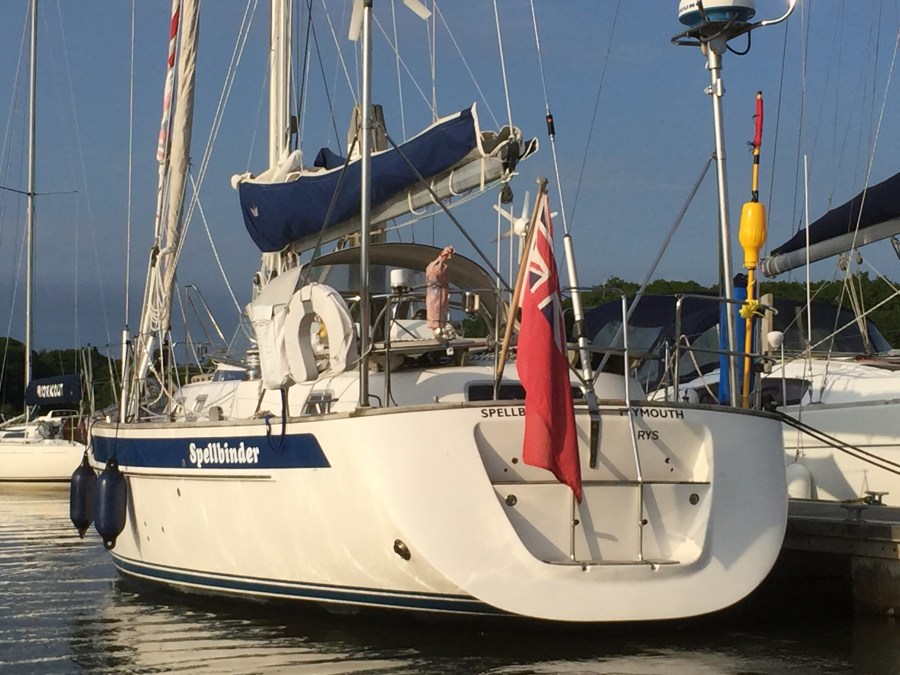
Spellbinder is a Hallberg Rassy 40, designed by Argentinian German Frers (www.http://germanfrers.net/). She is hull number 66, was built in 2005 and commissioned in 2006.
Layout. She has a centre cockpit layout and has 3 cabins – the main saloon, an aft cabin with a single and double berth, and a traditional forepeak with two singles which can be made into a double – in theory sleeping 7. She has an electric heads, shower and basin to port at the base of the companionway ladder, and to starboard a linear galley, equipped with a GN Espace Levante 3 burner cooker. .
Stats:
- Length Over All (LOA): 12.4m / 40’8 »
- Waterline length 10.6m / 34’9 »
- Draft (unladen): 1.99m / 6’6 »
- Beam: 3.82m / 12’6 »
- Displacement 10.00 tonnes
- Gross tonnage 14.79
- Fuel capacity 445l
- Water capacity 460l
Engine and Drivetrain. She is equipped with a Yanmar 4JH 4E 54HP engine, which has an additional 120A alternator for fast battery charging. She has a 3 blade Gori folding prop.
Bluewater fit-out. Spellbinder was upgraded by her first owner to make her bluewater (extended offshore sailing) capable, and I have since added various bits and pieces. She has a Spectra Newport 400 12v water maker, satellite communications (Starlink mini), and a long range HF radio (Icom 802 SSB linked to a Pactor 4 modem) as well as a number of other modifications appropriate to offshore passage making. These include fresh and salt water manual foot pumps, LED lights throughout, 6 12v Hella fans for ventilation, 5 x solar panels totalling 310W and a water towed generator (Aqua4gen). She has two diesel tanks which give her some 900nm of range, and two water tanks, and addition to her normal fridge she has a separate fridge / freezer.
Rig and Sails: She has a Selden rig with 3 spreaders and a removable forestay for a storm gib. All reefing is done at the mast, which has ‘granny bars’ for support. She has a double bow roller, to support a removable bowsprit for a cruising chute (116m²) with furling mechanism and a Rocna 20kg main anchor with 80m of 8mm chain on an electric windlass. She also has a Breeze kedge anchor on chain and rope. Other sails are a 125m² Parasailor, a fully battened slab reefed main (49.1m²) by Jeckells with 3 reefs enclosed in a stack pack, a genoa by Kemp (53.5m²), a working jib (38.9m²) and a storm gib (13.1m²) which hanks on to a removable forestay. She has a spinnaker boom stowed on the mast (Selden MDS batten system), adjustable genoa cars, running back stays, a backstay tensioner and Selden Rodstay vang.
Navigation. She has a Raymarine AIS B linked to an Axiom 7 Multifunction Display at the helm, which provides navigational data and which is also linked to a Raymarine Quantum radar. There is a Raymarine EV 400 quadrant-mounted autopilot system, along with a Raymarine i60 wind guauge and ST60 speed and depth gauges. She has a Hydrovane self steering system which also acts as an emergency rudder.
Electrical. She is powered by 6 x Rolls FS250 domestic 6v batteries giving a total of 720 aH, and a single separate 12v engine start battery. She also has an Ecoflow Delta Max 2 lithium battery which provides 240v offshore, enabling the use of an electric kettle, toaster, Nespresso machine and other electric appliances. The Ecoflow is charged by the engine with a DC-DC converter or by shorepower. There is a galvanic isolator, Victron Centaur 120-240v battery charger and a Mastervolt battery manager. The modifications outlined above allow her batteries to be charged by engine, solar or towed generator. The solar and towed generators are each linked to separate charging mechanisms, giving redundancy.

