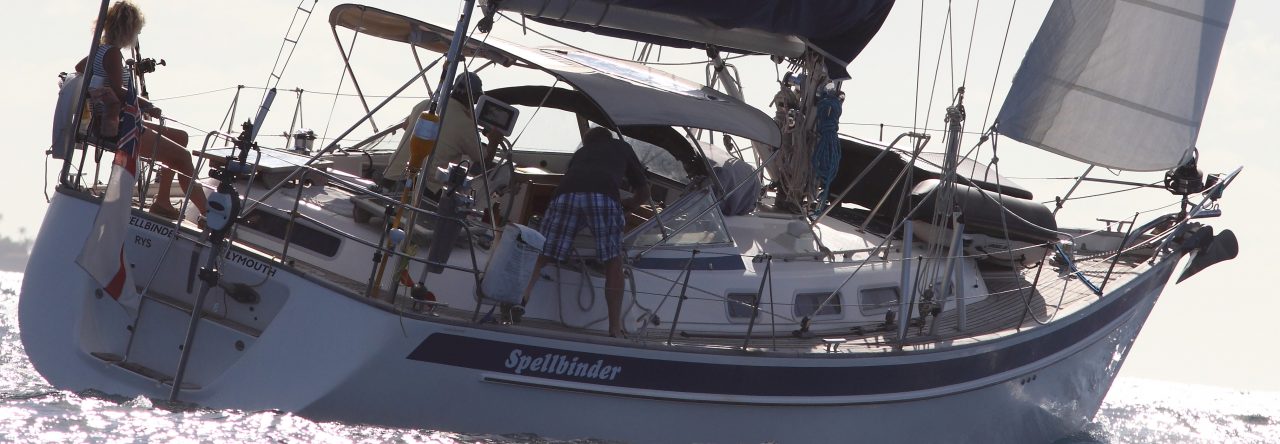
Below is a link to short, very amateur video which gives some idea of the excellent return trip we made from Guernsey – downwind for 14 hours, from St Peter Port to Cowes with the engine being used to get out and into our berths. In particular there is footage of the Hydrovane and the water generator in action. I do look rather grumpy in it but I was concentrating on not falling over mid-Channel! If only more sailing was like it…
Author: Nick Nottingham
Hydrovane, Herm and Homeward Bound
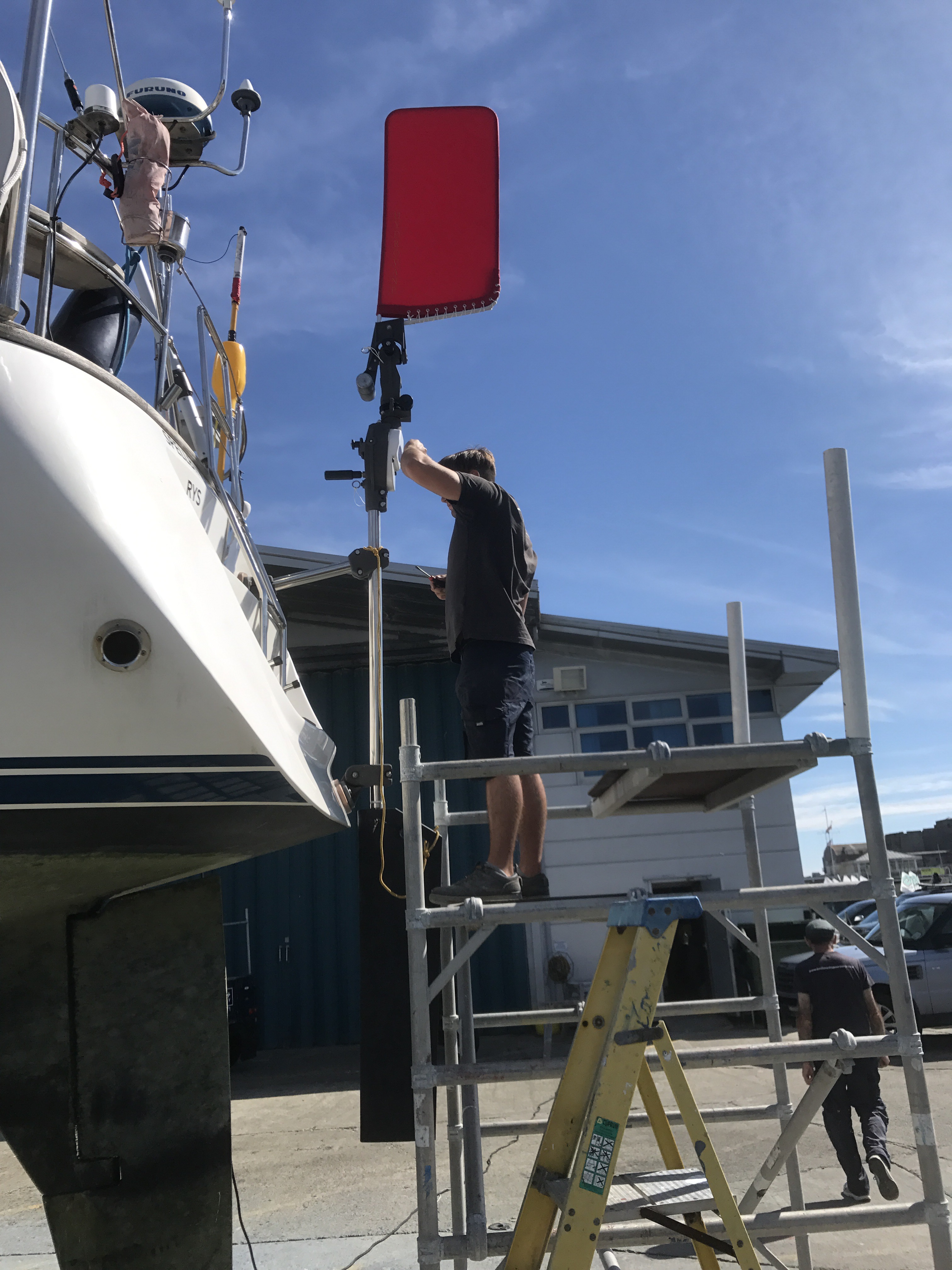
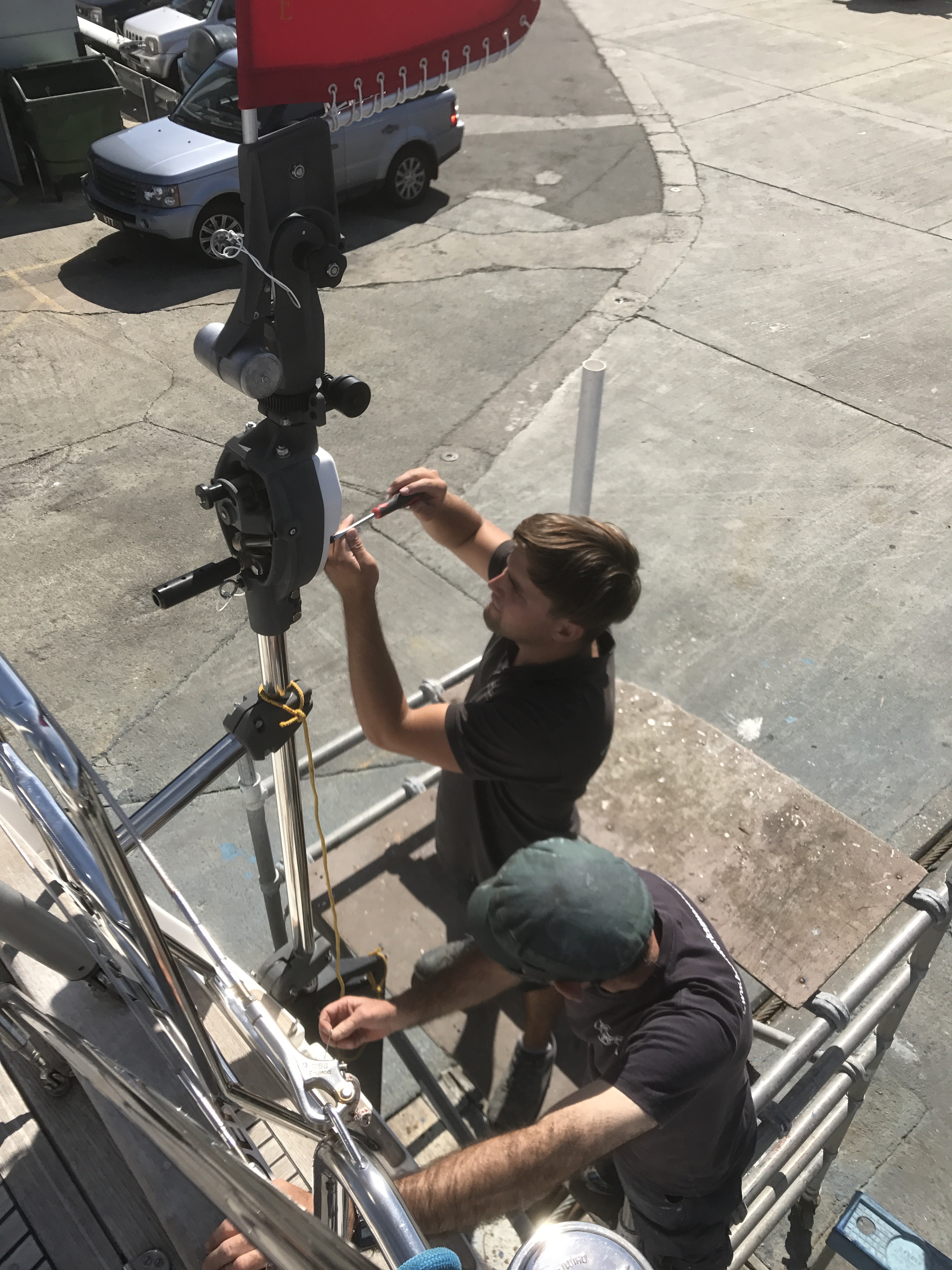
The Hydrovane fitting went well, and having conducted the final commissioning tests I signed off the work, paid the bill and we slid back down into the water using the Boatworks + rail system, a very effective way of lifting boats in and out. Below are some photos of the final installation and the team fitting the gear:

After our lift in we headed over to Herm, a delightful island a couple of miles away from Guernsey. Negotiating the many rocks and shoals in the area, we tried out the Hydrovane in light airs with success. Anchoring in Shell Bay to the east of Herm, we dinghied ashore and walked around the island, which took an hour and a half. The weather was delightful so we decided to swim back to the yacht, and the boys took the Go Pro and dived down to try and photograph the buried anchor. Below is a photo of Spellbinder in what was a typical Channel Islands anchorage:

After a final night in St Peter Port I left at midday with Tom and Jonty (Sue having flown home to collect our car from Devon). We had an immaculate passage back – putting up sails and cutting the engine just 250 yards from St Peter Port harbour entrance, and dropping sails a similar distance from Cowes. All downwind, it made for fast and enjoyable sailing. We had a good push up the Alderney Race (timing is everything) as this screenshot of the plotter shows:

With a through the water speed of about 6.5 knots, we had about 4 knots of favourable tide (SOG = Speed Over the Ground). We were at Neaps, but with Spring tides I have known double the rate.
During the passage the Hydrovane again proved its worth, steering us straight for most of the passage. We also tried out the water generator, which charges up the yacht’s domestic batteries by turning a torpedo-type propellor through the water. Tom did some press ups on the foredeck, and both boys cooked. Coming into the Needles by a cardinal buoy called Bridge, we had a period of boisterous wind over tide before edging into Hurst Narrows just as the tide was turning in our favour.
We tied up in the RYS Haven at 3am, after 14 hours and some 90 nautical miles sailed, trying not to wake anyone up. After the usual 8am raising of the Ensign ritual we enjoyed the Castle facilities and had breakfast, which was superb. We were tired, but content.

Herring bones, mackerel, dolphins and a Kobra (sic)
As the title suggests, this is a blog of 4 animals – 2 fish, a mammal and a reptile!
We have had a great week at Dittisham, catching up with family and friends and enjoying our house September Cottage, while Spellbinder has been moored on a buoy in the river. The weather was that of a typical British August – sometimes fine, sometimes dull, sometimes rainy. We managed three BBQs but generally pudding was eaten indoors. I thought of my friends Julian and Karen, currently in Portugal on their Halberg Rassy, for whom such considerations will be distant memories. But we enjoyed the view from our terrace.

We also enjoyed some walks and I spent some time buying and fixing bits and pieces on Spellbinder. The salt water foot pump now works (on long crossings water is a precious commodity, and it is good to have salt water to cook and do the washing up). I also spent a delightful afternoon sewing on a new leather covering to the wheel, using a herringbone stitch some 500 times. Much patience and precision is needed, and I have a dearth of both, but the result was satisfactory:
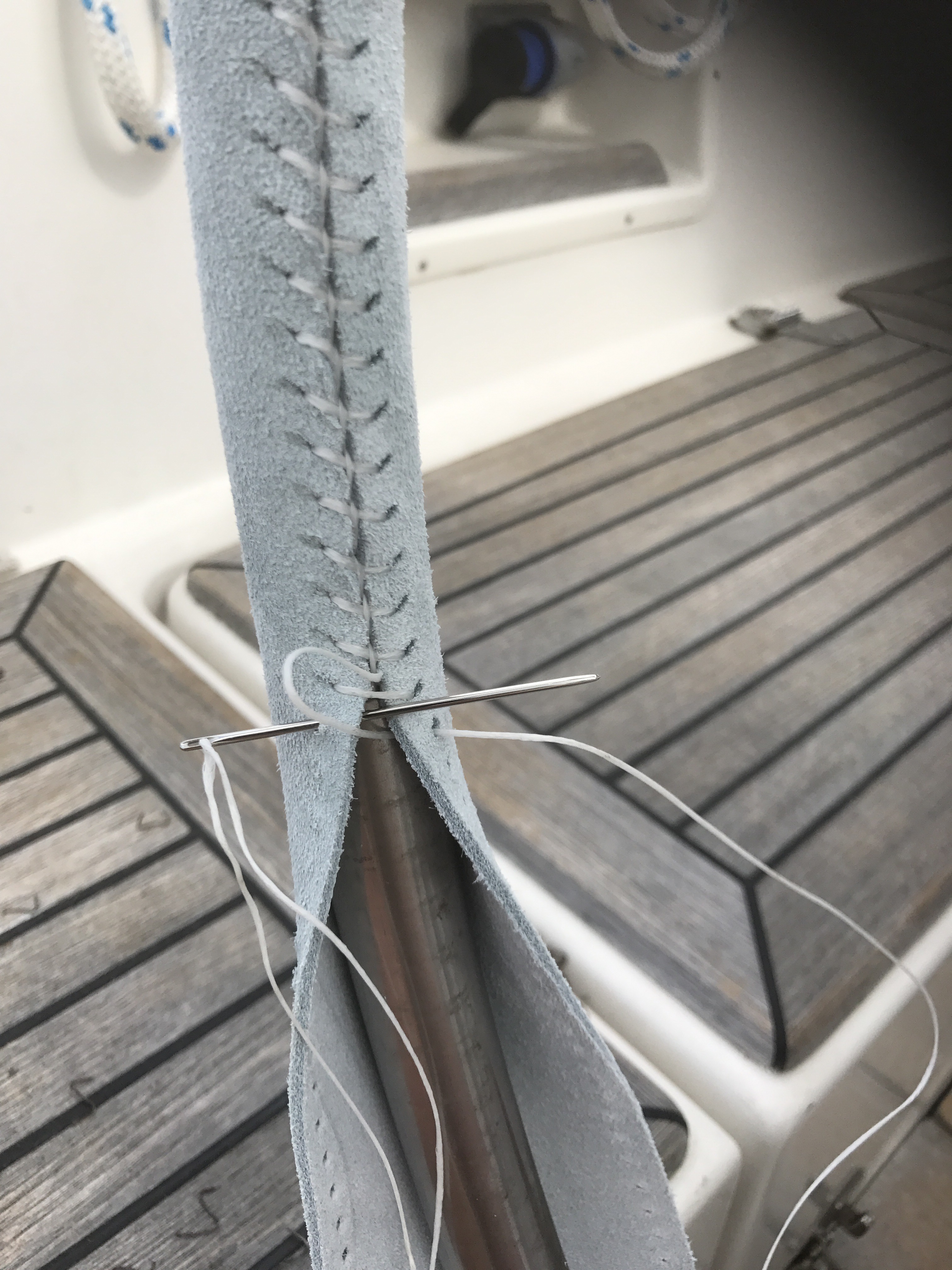
A full picture will follow when eldest son Tom has tied me a Turk’s Head knot on the top, marking the centre point (straight rudder), as is traditional.
We also fished from Spellbinder and Jonty caught many mackerel, filleting them and frying them up for a delicious supper on board:

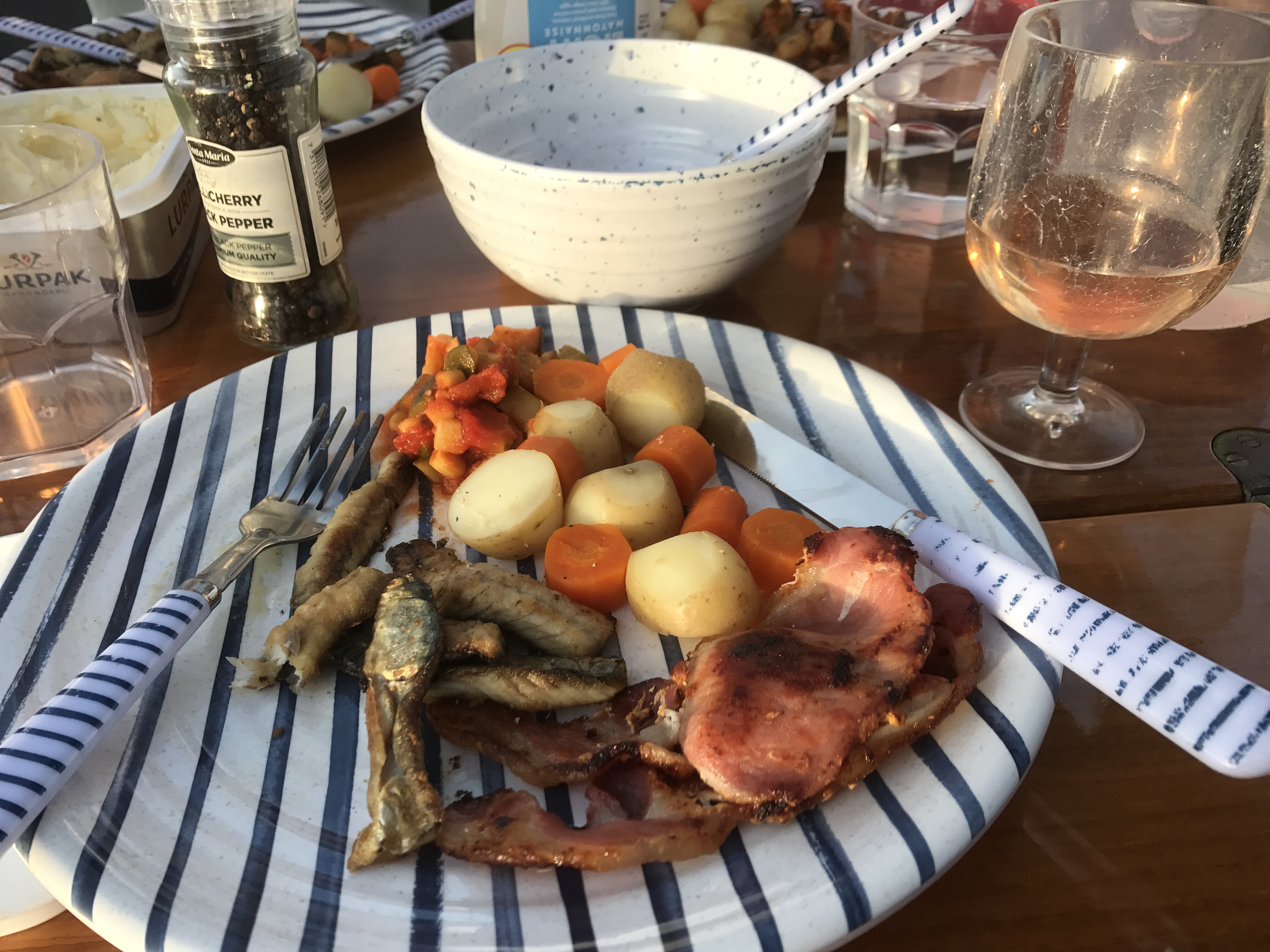
The third animal arrived in a huge box. It weighs 20kg and a similar one kept me very stationary (as is its job) on my last yacht. I fixed it to Spellbinder’s bow and it has already proved its worth. It is a new style anchor, called a Kobra 2, and will give me peace of mind in the years to come. Below is a picture of it with Dart mud still attached:

While in Dittisham Jonty and I also motored round to a cove just east of Dartmouth called Pudcomb. We anchored at the foot of a beautiful National Trust property called Colton Fishacre (owned once by the D’Oyly Carte family, of opera fame). It was a nice day anchorage where we fished, practised rowing the new tender and had lunch.


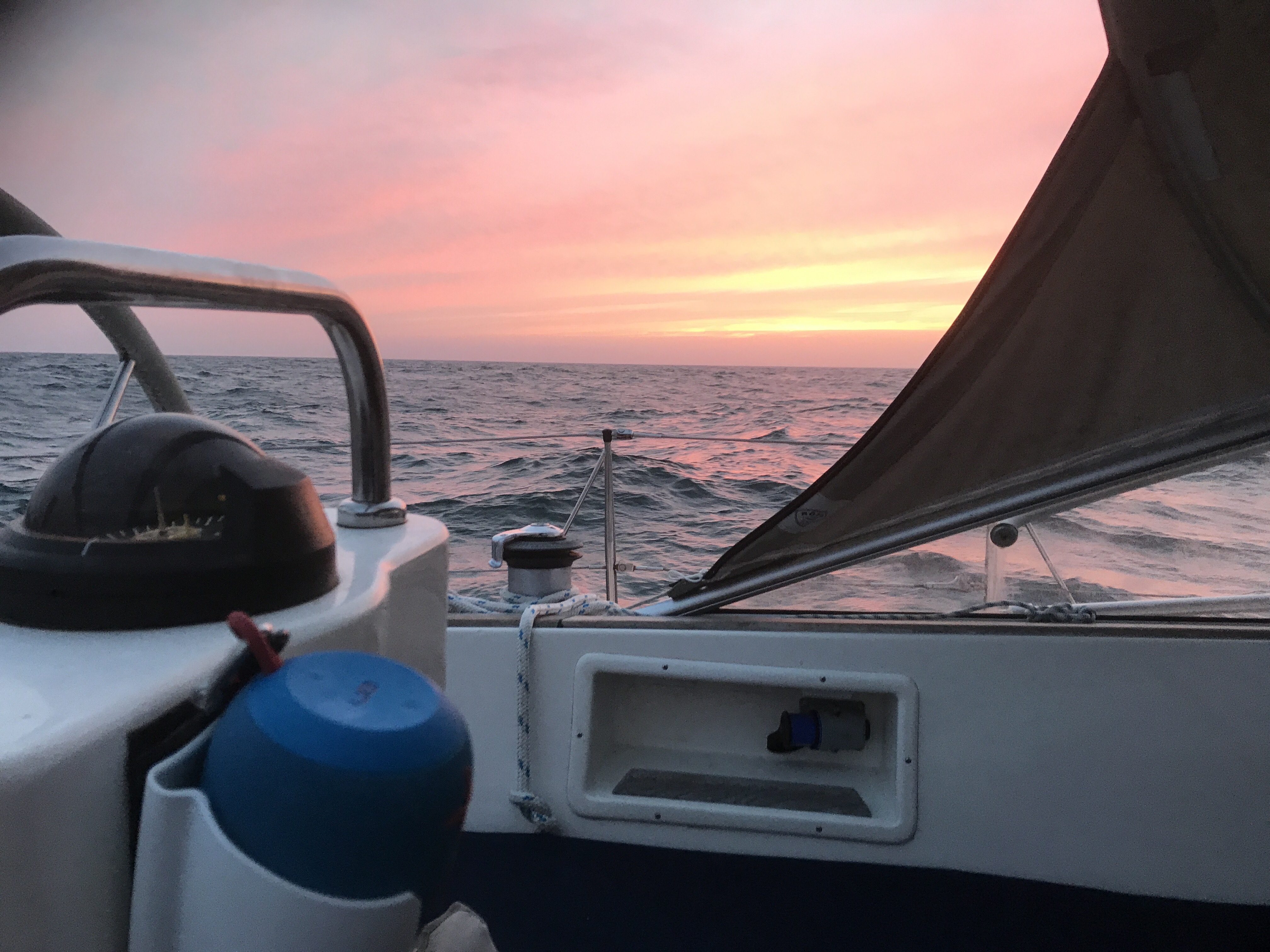
Our time in Devon came to an end after Tom returned from a music festival in Cornwall. We motored across to Guernsey, leaving at midday and arriving around midnight. Although lack of wind and some rain made it a bit of a dull crossing (we discovered that our cockpit enclosure kept out the worst of the showers), the highlight was the fourth animal, in the form of dolphins who joined us a couple of times, playing under our bow for a while. I think they were bottlenose – quite large, and blunt at the mouth end. Perhaps someone can definitively identify them from the photos below.


We arrived with the tide whisking us around to St Peter Port in the dark. Now in Guernsey for a couple of days, we are hauled out and a self steering system called a Hydrovane is being fitted. More to follow…
Westward Bound
The summer holidays (part two – UK) began as we arrived on the Le Havre to Portsmouth ferry and drove around to the Gosport side. As Spellbinder was on a buoy up river, son Tom and I were dropped off to blow up an inflatable kayak, paddle out in the darkness, find the yacht and bring her to Dolphin marina where we could load our stuff and crash for the night.
The following morning was admin day – car servicing and house hunting – and we set off for the Isle of Wight later in the evening, driving into a southerly Force 7 and negotiating the entrance to Bembridge Harbour at around High Water. Once in, we managed to berth successfully in the 25 knot gusts and began an enjoyable 3 day, very sociable stay on the island.
The passage west started on Saturday 5th August, into some unrelenting westerlies and the crowded Solent (it was Cowes Week). Once out of Hurst Narrows we had a boring and up and down crossing of Poole Bay, which I will remember for passing squalls and motoring in a choppy and lumpy sea. On arrival we found a lovely spot to anchor at the south end of Studland Bay, not far from Old Harry rocks, sheltered from the wind and fetch.

Calm having returned, eldest son Tom cooked supper (a rare but very welcome treat) and we got our heads down, waiting for the tide to turn. We left at dusk, heading west south west into a nice NW sailing breeze. While passing Swanage we were treated to a firework display, before we settled into a night routine with each of us doing two hours off, two hours on.
For the first part of the night the sailing was great – a close reach on the starboard tack, we raced past Portland Bill and south of the Shambles. At 3 am the wind backed and we had to furl in the genoa, and motor. Tom was treated to a wonderful pre-dawn, watching Venus rise and the sun, in russet mantle clad, walking o’er the dew of yon high eastern hill (thank you WS):
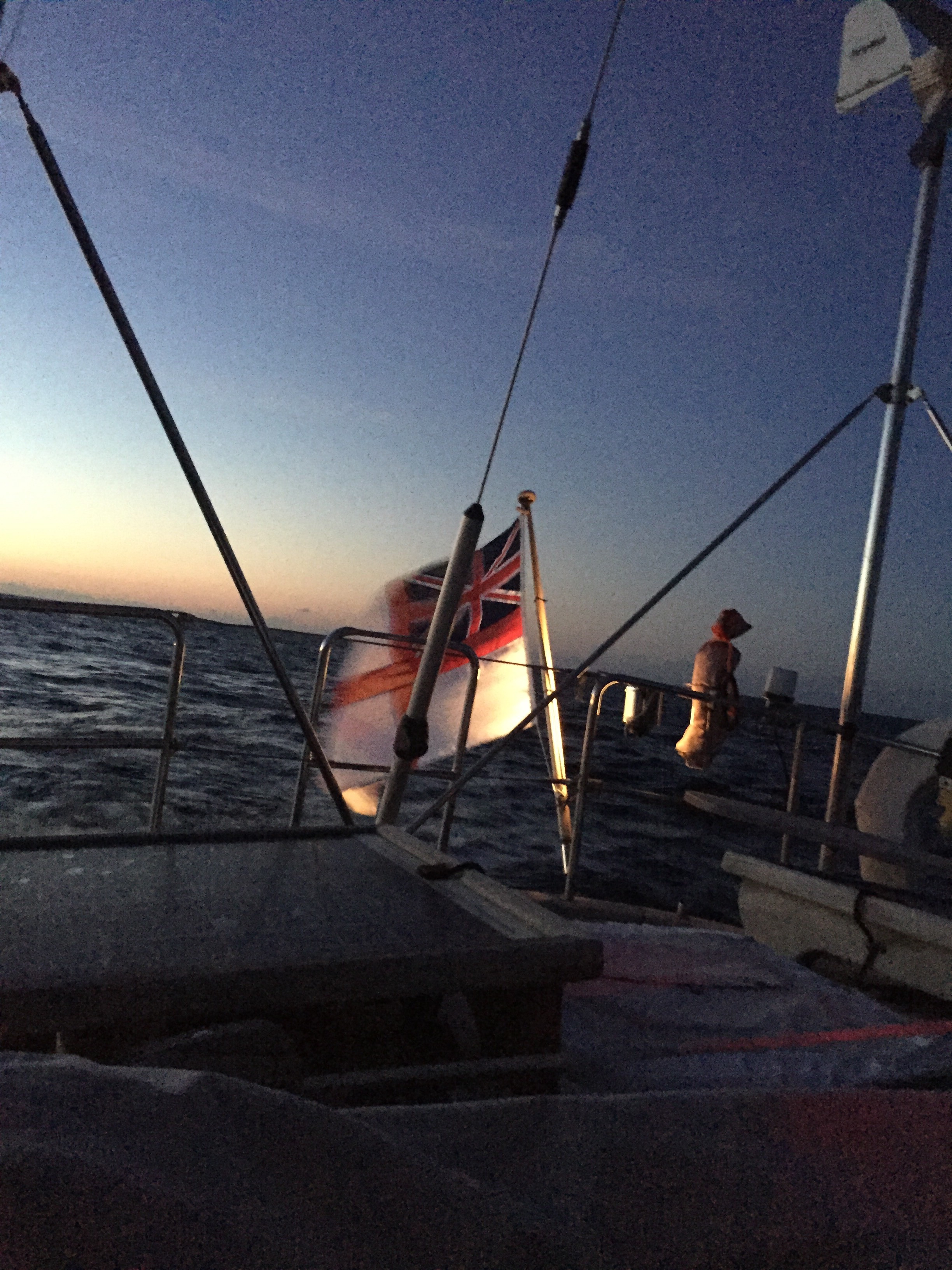
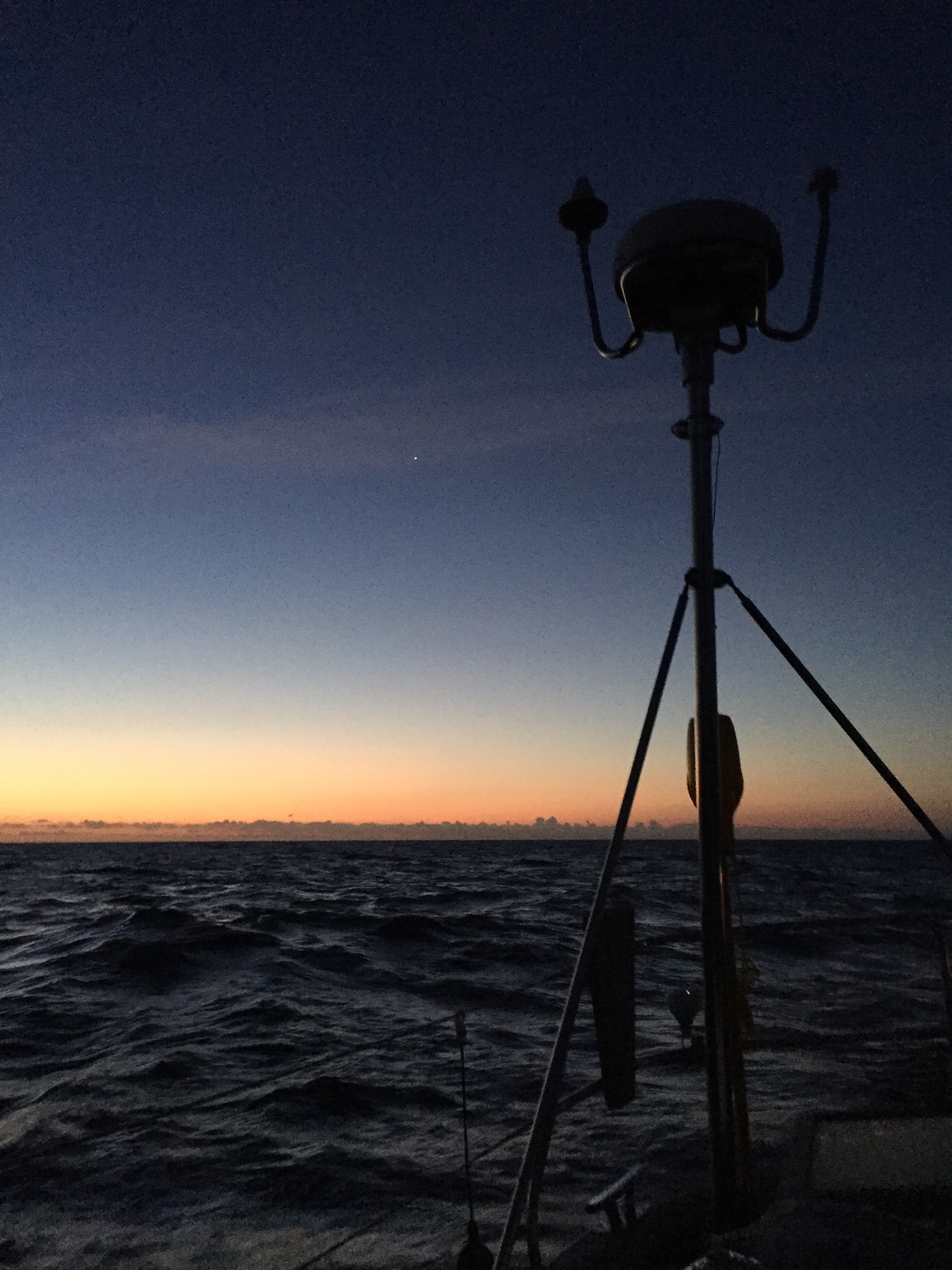
As the sun rose properly we neared the Mewstone rock off Dartmouth and headed into the river, having had breakfast. We followed a quick coffee with fellow RYS members Peter and Janet Melson (on a buoy awaiting engine problem diagnosis) with a trip up to Dittisham, from where we will be based for the duration of our time here. A great trip westwards, with Spellbinder showing her credentials again.

Video of the June Channel Crossings
Thanks to Charles, one of my able crew for the June crossings to Normandy and back, there is now a short video clip available. Charles also plays a starring role and it is he who is aiming the camera stick. It is a good cross-section of the pleasant downwind trip over, a bit of lounging under the bimini drinking beer at the Port de Plaisance in Ouistreham, and at the end some fairly boisterous conditions (3 reefs in the main) as we neared the Isle of Wight on the way back. The camera does tend to flatten the waves though! Enjoy:
On sewing and boat jobs at home
When I’m away from my yacht I find it relaxing to have things to do related to her, and bringing items back from her to fix, paint, varnish or toy with is a source of disproportionate pleasure! And so it was yesterday I sat down in our home in Besançon, hundreds of miles away from Portsmouth (let alone the nearest bit of sea) and addressed my old Singer sewing machine.
I bought it a few years ago but it was originally made in Glasgow in the 1920s. Very robust and very basic, it is beautifully engineered and a credit to its era and the Great Britain of the day. It was, however, definitely not aimed at the male market back then, as the blurb shows:
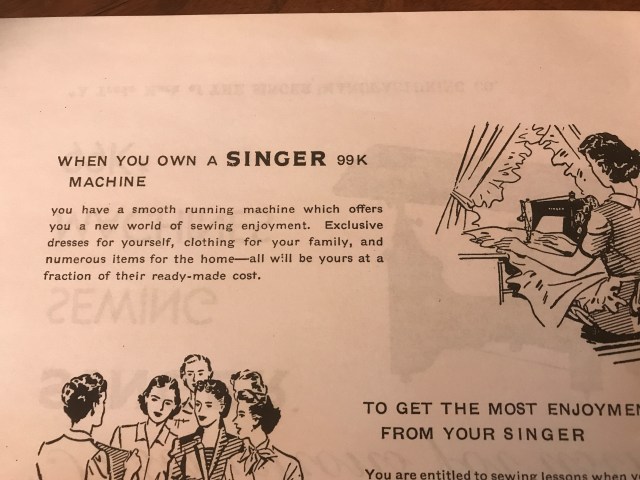
But I find it a thing of beauty, and it if you actually read the manual carefully and bother to thread everything as it should be, it is a very efficient way of repairing sails and making curtains and covers and so on. I will definitely take it on long voyages. The job on hand was to make 3 new curtains out of material with backing, to prevent light from coming in under the hatches in the aft cabin and forepeak.
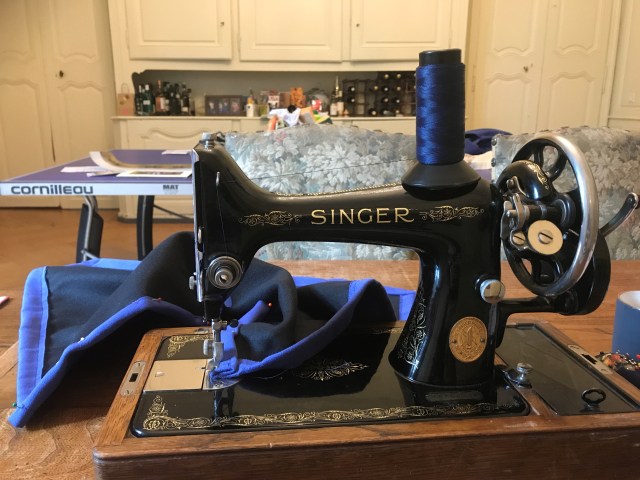
Three hours later the job was done. I am no expert and improved decidedly as I progressed – but I hope future crew will sleep more soundly and for longer thanks to my endeavours!
![IMG_2079[1]](https://travelsofspellbinder.blog/wp-content/uploads/2017/06/img_20791.jpg?w=640)
Balmy Solent
The exeat weekend saw us drive around the Solent, reacquainting ourselves with various haunts from our Kianga days. We left Gosport on the tide, heading westwards towards the setting sun on a very hot evening, and were surprised and relieved to get a place rafted up on Lymington Town Quay. This is one of my favourite places in the Solent – you are right up there amongst the hustle and bustle of the Town, and right opposite is a chandlers and a good pub – what more can one want? We arrived at sunset and went for a stroll up the high street, before returning to what was a surprisingly quiet night.
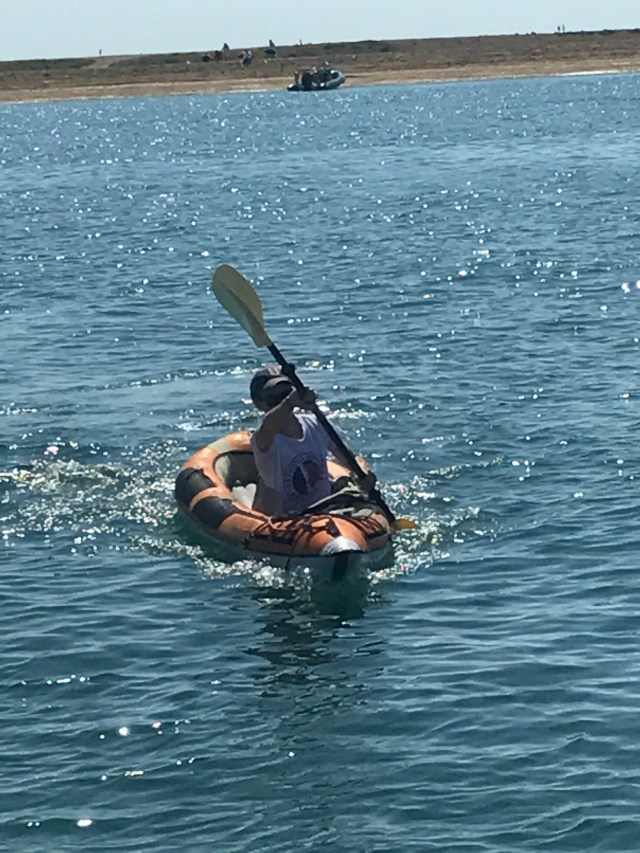
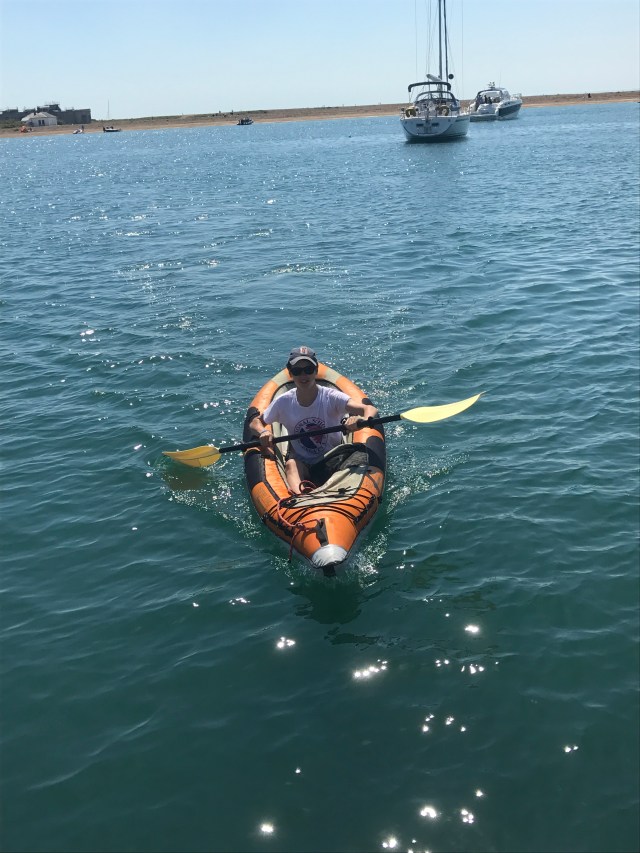
The following morning the chandlers relieved us of some money. We are at the stage of needing small things like cup and toothbrush holders, as Spellbinder now has pretty much what she needs. After picking up no 1 son from the train station (he wore a Saturday night party in Bath on his face), we headed over to Hurst Castle to anchor for lunch. All very civilised, and Jonty blew up one of our inflatable kayaks and paddled around a bit, even taking a brief swim. There is a transom shower attachment which even has a hot and cold water mixing arrangement – what luxury! The water at this time of year remains cool though. The two best swimming months in the Solent are September and October in my opinion – when the weather is fine, that is.
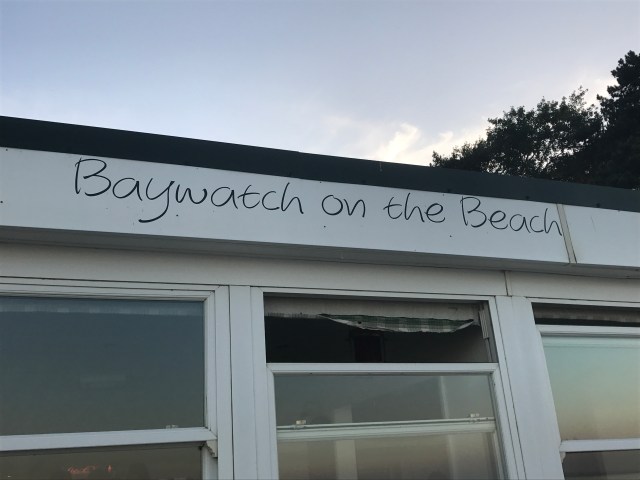
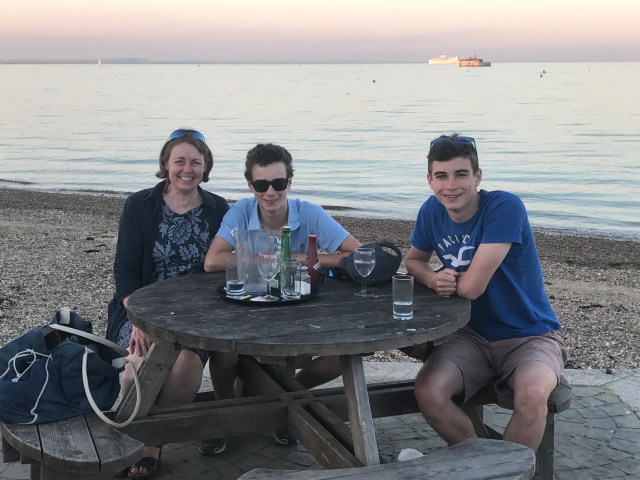
After lunch we took the tide all the way back east to Bembridge, wending our way in via the buoys at 30 minutes before high tide. It being a Sunday night, things were quite quiet and we got an alongside berth. During a stroll we came across the wonderful Baywatch on the Beach cafe – it looks fairly basic, but the seafood is excellent and we treated ourselves to whole sea bass, steaks and other delights. It must be a great place for breakfast too, as it faces the rising sun. The service was great. In the morning we motored back to Gosport, placing Spellbinder on her buoy while Tom and I kayaked back down Portsmouth Harbour – quite an adventure, with all the ferries gadding about. A few pictures tell some of the tale of a great fun, although windless weekend. I managed to make the family smile while taking the photo by inviting them to say the word ‘flange’, which is a pretty horrid word!
Windward return from France
After the battlefield tour we deliberately waited 18 hours to catch some wind. I had no desire to motor across the Channel and a slight pressure squeeze was predicted before the arrival of the high pressure system we have subsequently enjoyed. My crew, Charles and Adam, agreed with the plan.
They spent the afternoon buying food and I visited the French chandlers to buy one or two bits and pieces still missing – hose, anchor ball and dividers of all things. We then got out the sails we hadn’t seen and looked at them on the pontoon. The working jib and storm jib are virtually unused, which bodes well for strong winds in the future. After a good seafood meal in a local restaurant we turned in early and got up for the 04.30 lock out, chatting to some French fisherman while in the lock who complained that ‘La mer est vide’.
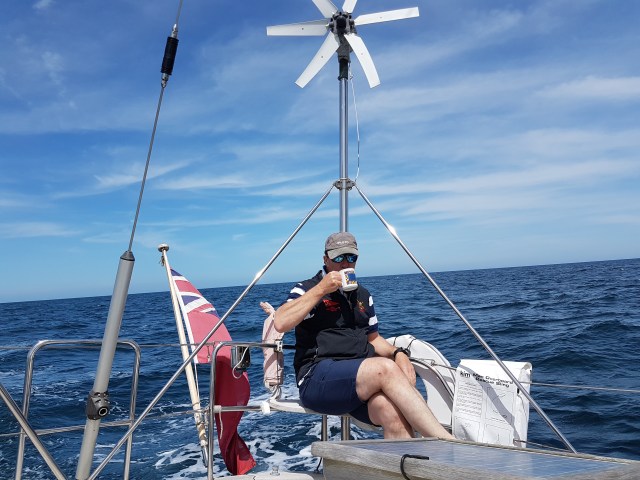
The passage was in two parts. Early on, we had a W 3-4 which allowed for full sails. The wind even dipped behind the beam for a while and we raised the furling gennaker. The picture below sums up the first half of the passage, as I drank good coffee while sat on the ‘gin and tonic’ seat.
Thereafter the wind rose and we progressively reefed until we were in a westerly force 6, with 3 reefs in the main and half a genoa, close reaching. We had used the autopilot for most of the passage hitherto but for the last part Adam and Charles helmed to gain experience. Spellbinder was quite excellent, tracking straight and not slamming in the Channel chop, which was exacerbated as we closed with the Isle of Wight by wind over tide. As we passed by Nab Tower things calmed down and we sailed all the way up to Portsmouth Harbour entrance.
It was a great fun crossing – very different to the downwind one to get us to France but equally satisfying. It was great to test Spellbinder in some more blustery conditions. We moored up and Charles and Adam cooked supper, before heading off. They were excellent crew – come and sail on Spellbinder again please! There is nothing better than the sight of crew arriving with bottle in hand, asking what needs doing, just as they did. Thank you both – it was a pleasure!
A floating HQ
For the last 10 days Spellbinder has been in the port de plaisance in Ouistreham. From 12-14 June I used her as a ‘floating HQ’ while running a battlefield tour of Normandy with my work colleagues. Ouistreham is well positioned, being adjacent to the D Day beaches and not far from a lot of the actions which followed as the Allies attempted to break out of the beachheads and liberate the rest of France, before heading further east. For the cognoscenti, we explored Sword and Juno beaches (British and Canadian-led respectively), Hillman fort and the approach on Caen, then Omaha (US) and the adjacent and remarkable Colleville-sur-Mer cemetery (opening scene of Saving Private Ryan) and then finally the actions which lead up to the closure of the Falaise pocket, and the German counter attack at Mortain. We finished in the excellent museum at Bayeux, and also took time to visit Pegasus Bridge and its museum. The daughter of the owner of the café next to the bridge in June 1944 (Madame Gondrée) still runs it, and seeing my British uniform offered me and my driver some extra cake to go with our tea…
 Entertaining allied officers on board
I took the opportunity to entertain the command group and also some British and German officers we had invited to accompany us. The weather was fine and we also found and put up the bimini, which gave us some good shade from the sun. Perhaps it will next be used in tropical climes…
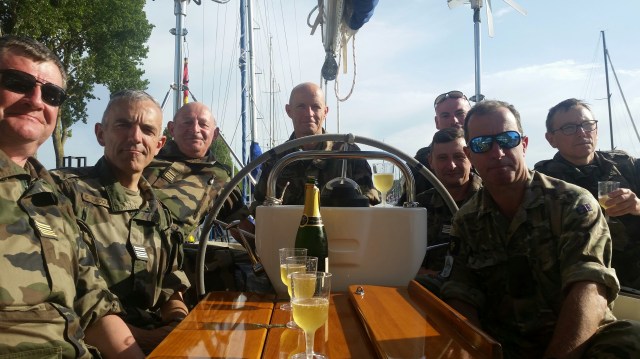 The Command Group
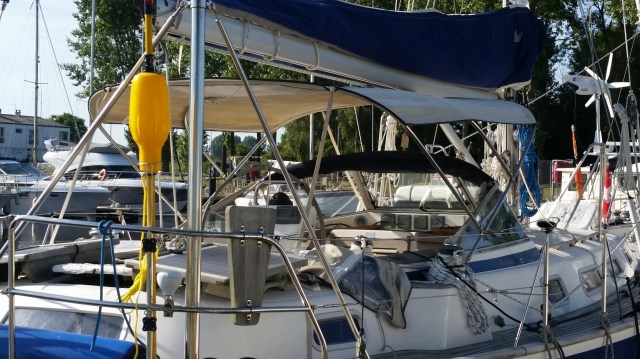 Bimini in situ
First Channel crossing
A 0330 start was required to maximise the tidal currents around the Isle of Wight and to give us the best chance of making Ouistreham, 104 nautical miles distant, in time for dinner. For this first cross Channel trip on Spellbinder I was joined by Crispin, Adam and Charles, the latter two having driven all the way down from Catterick to help out.
And what a sail we had, with the wind ‘just behind the ear’ (broad reaching) for most of it with the furling gennaker, a big downwind sail, flying most of the time and giving us the necessary power. The sails went up just outside Portsmouth harbour and down again just outside the destination – very economical on fuel! We tried the towed generator (a torpedo-type device thrown over the stern, which is connected to a rope which in turn is connected to a generator to charge up the batteries). The skipper cooked a big cooked breakfast for all and we enjoyed Spellbinder’s power and stability in some ideal conditions, while breaking down into informal watches and catching up with sleep, as well as some dozing in the sun.
We finished by ‘goose-winging’ – the main sail on one side and the furling genoa poled out on the other – with the wind dead behind us. With luck on our side, we entered Ouistreham as the lock was opening, allowing us to go in and attach ourselves to the side wall of the lock as it filled up, then opened up to let us in. We celebrated with a glass of champagne and after finding ourselves a berth in the port de plaisance we wandered into town and had a fine meal in a nearby restaurant. The following morning the crew departed on the Brittany Ferries sailing to Portsmouth while I chatted to the Hallberg Rassy Owners’ Club, who coincidentally were passing through on a rally.
In sum, I’m hugely pleased to have taken Spellbinder across and she proved her worth. We sailed 110 miles in 14 hours 30 minutes, averaging 7.5 knots. All systems appear to be working and I look forward to the return journey in a few days.
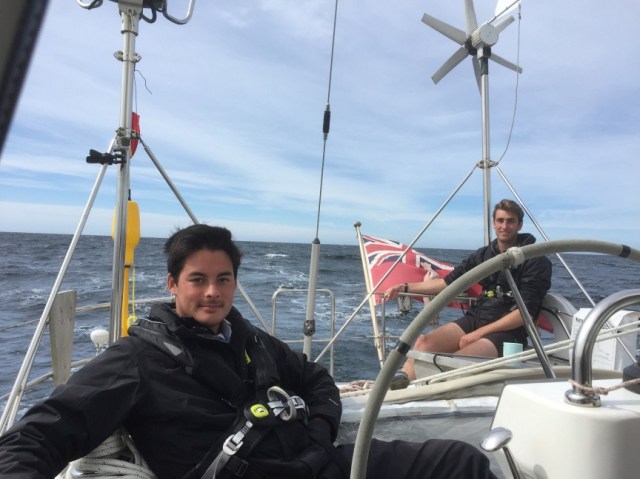
Adam and Charles enjoying the ride, mid English Channel
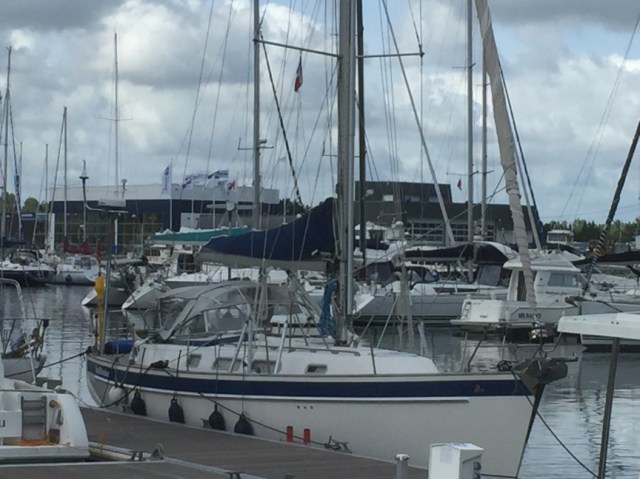
Spellbinder in Ouistreham
Torqueedo, 3D tender, Parasailor and Boracol
Four terms which didn’t mean much a few weeks ago, but which were very much part of recent days spent aboard Spellbinder en famille over half term.
Torqueedo is the make of Spellbinder’s new outboard. It is novel in that it is electric – no more petrol, outboard engine or gearbox oil on board, and no more starting with a pull cord – you just twist the tiller handle. It comes in three parts – shaft and propeller, battery and tiller. Putting it together is simplicity itself and takes seconds. Being able to break it down into its constituent parts makes it very transportable and light. The tiller has a built in GPS and computer which shows residual battery power and range. Reports suggest that with the chosen battery, and if you don’t go at top speed, you will get at least a couple of hours motoring. Tom and Jonty certainly enjoyed using it in the Beaulieu river in the 3D tender, a French make which comes with removal black and white neoprene covers (useful for protection against the sun in the tropics). They found the combination very manoeuvrable with the outboard delivering instant torque.
Parasailor is a type of sail. Rather like a spinnaker, it is a downwind sail but unlike a spinnaker it doesn’t need a pole, and can be flown with two sheets (ropes). It is symmetrical in shape but the key feature is a large wing about two thirds up. This wing fulfils three functions – lateral stability, lift and a place through which the power of sudden gusts can dissipate. This makes it a really versatile, powerful and reliable sail. We had great fun with it, sailing between Yarmouth and Seaview at over 8 knots through the water in about 12-15 knots of true wind. A couple of other yachts took photos – it is quite a rare sail to see in the Solent, and is typically used for long trade wind passages.
Boracol is a treatment for teak – and Jonty spent a couple of hours painting it on the deck for me. It gets rid of the inevitable greening and spotting which our humid climate encourages and after 10 days the teak is whiter and clearer. We await the results!
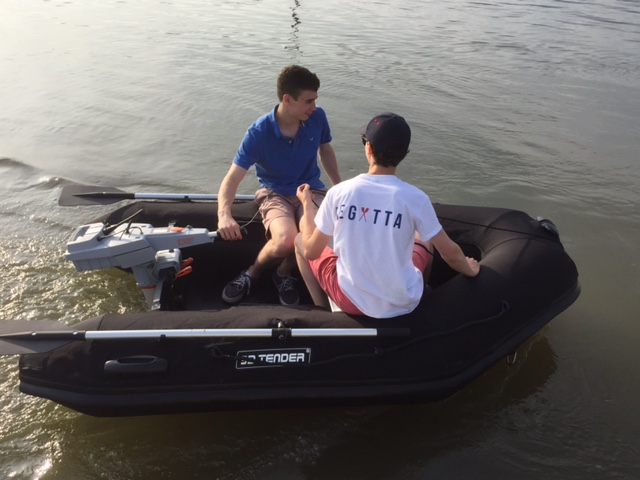
Tom and Jonty playing with the Torqueedo, and the new Parasailor sail roping us along eastwards down the Solent.

It was a fun weekend, in company most of the time with the Hickmans, aboard Alberta Rose. From Gosport we headed to Beaulieu, then Yarmouth, then back to Gosport via Seaview and a walk along the beach towards Bembridge.
Maintenance, repairs and planned upgrades
Recent work on Spellbinder includes new standing rigging, a new spreader, new running rigging, a new rudder bearing, replacement of several seacocks, new life jackets and harnesses and a full kit out of domestic niceties!
She will shortly have a new offshore life raft (6 man canister) with hydrostatic release mechanism, a new danbuoy and holder, CO and smoke alarms, a 12v hoover, a kettle and a guest book!
Immediate work also includes a full gas safety check. For the summer, I plan to haul her out, have her hull blasted and epoxied, and Coppercoated (a type of long-lasting antifoul). Thereafter, new sails, an electrical re-fit and a Hydrovane self-steering system beckon…
First forays
Following the delivery trip we spent a busy day heading to Sainsbury’s to kit Spellbinder out with crockery, cutlery and bedding, and other domestic essentials to get ourselves going. With a sort of managed chaos below, we met up with David Anderson and his friend Tim Wolfe-Barry, who had chartered a Vancouver 35 called Fusilier , and we sailed off to Cowes where we berthed in the RYS Haven. It was a downwind sail, with a F 4-5 right behind us and Spellbinder behaved herself impeccably. We invited David and Tim aboard and drank to Spellbinder’s health, before heading off to a most enjoyable dinner in Cowes (DB’s on the High Street – we were lucky to get in there, as it is very small and like dining in someone’s front room. The food was excellent).
The following morning we headed to Hamble Point to join the Winchester College Sailing Club rally, and had a very agreeable couple of days based out of the Royal Yacht Squadron undertaking some gentle racing, with Sue, Tom, Anna Cockell, Eric Billington and Alec Prosper-Orr on board as crew. Much to my surprise Spellbinder won line honours in some great sailing conditions but came third on handicap! The final sail on Sunday was with Tom and his friend Tiger Tellwright – back to Portsmouth to Spellbinder’s buoy.
Purchase and delivery trip
I had a bit of a wait for Spellbinder, as following the survey a couple of technical issues had been identified which needed resolving. These included a new rudder bearing, the replacement of a few of the seacocks and the replacement of the standing and running rigging. A spreader needed replacing and they found that the coaxial cables inside the mast had been crushed and new ones were required.
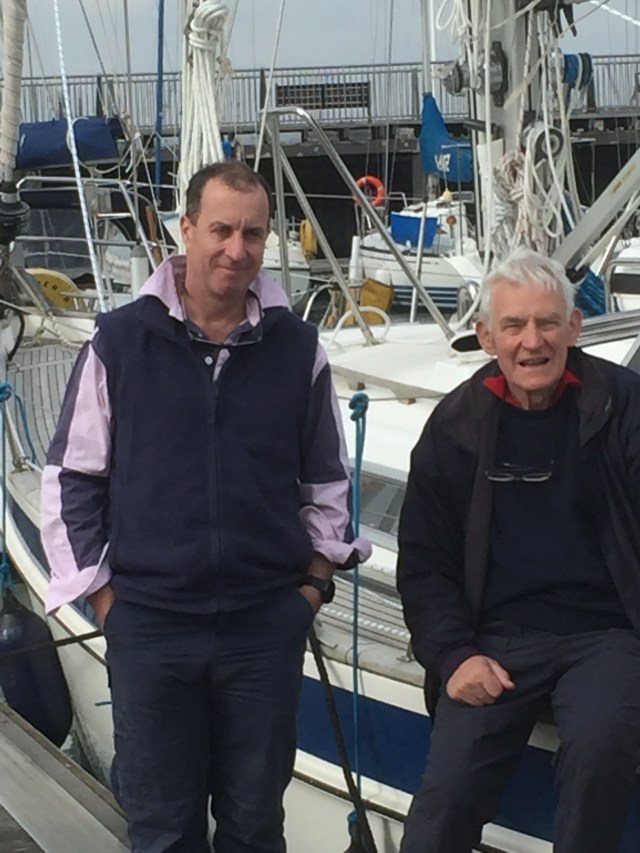
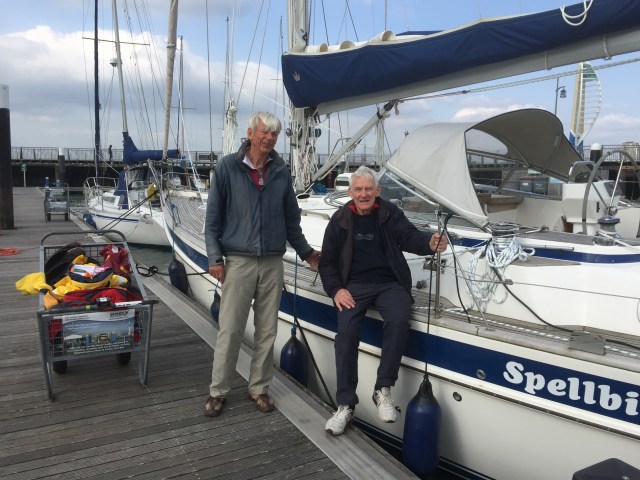
The day eventually came, after a couple of delays, and on Thursday 4th May 2017 I met up with the owner and his sailing friend Martin and went through a list of things I wanted to cover. Once complete, I signed the paperwork and we headed off on the delivery trip – a delightful trip with the tide round to Gosport, with a light northerly breeze allowing us to sail most of the way. We had to put one reef in around Gillkicker Point and overall it was a fitting and civilised start to my ownership. Once docked in Gosport, we paused to take photos and Henry and Martin left me to it – with a bit of emotion, I suspect, as they had invested a great deal of time and energy into Spellbinder, and had kept her in great shape. A couple of photos show the moment.
The search for Spellbinder
I have enjoyed sailing yachts since my twenties, and progressed over the years sailing on many different types and following the RYA syllabus up to RYA Yachtmaster (Ocean), culminating in being the mate on a Challenge 67 yacht on passage from Rio de Janeiro to Cape Town, calling in at Tristan da Cunha. I bought my first yacht in 2007, a Moody 33 Mk II called Kianga. I enjoyed many thousands of miles sailing in her as my family grew up. We ranged along the UK coast from Southwold in Suffolk to Scilly, and across the Channel we ranged from Ouistreham in Normandy to Piriac-sur-Mer in Southern Brittany, and many points in between. She was a wonderful, sturdy yacht which looked after us in challenging conditions. She gave us some excellent shared experiences but by 2016, with my sons aged 13 and 15, we had grown out of her size-wise and I reluctantly sold her.
The search for a replacement began straight away although I did not let on! I knew I wanted a cruiser, rather than a racer, and wanted a larger yacht which would be capable of taking me across oceans while being small enough to cruise home and European waters. By March 2017 I had settled on a Hallberg Rassy 40, in large part for their build quality, seaworthiness and accommodation. There were few on the market but I eventually settled on Spellbinder, which was for sale through Transworld Yachts in Hamble Point. She had been bought new in 2006 by Henry Buchanan, who sailed her in the Baltic and undertook and Atlantic circuit before cruising the Mediterranean for a few years. A Royal Cruising Club member, he is the author of the Atlantic Spain and Portugal Pilot published by Imray under the auspices of the Royal Cruising Club Pilotage Foundation (RCCPF).
Here is the Transworld video of her:
I agreed a price with Henry and Spellbinder became mine on 4th May 2017.
 The Travels of Spellbinder